
In the current context of higher education, it is crucial that teacher training is prepared to respond to the dynamics of an educational environment in constant change. The RAPID model was designed to integrate five essential areas of academic staff development: Relationship, Assessment, Pedagogy, Innovation and Digitalisation.
This model is grounded in key theoretical contributions, such as the understanding that social interactions act as a catalyst for learning [1], and that continuous feedback is an essential tool for the development of self-regulated learning processes and reflective learning skills [2]. Theories such as Bloom’s Taxonomy also guide the definition of educational objectives that foster critical and analytical thinking [3], while Biggs’ Constructive Alignment ensures that learning objectives, teaching activities and assessment methods are coherently aligned [4]. The final two components of the acronym — Innovation and Digitalisation — reflect a central idea of Piaget’s theory of learning, constructivism, which argues that teaching should prioritise active exploration and problem-solving, as this is how human beings actively construct knowledge through interaction with their surroundings [5].
Accordingly, the Ensina+ strand aims to cover a set of training areas that provide teaching staff, in a simple and practical manner, with tools that can be rapidly integrated into their daily practice and connected with the empirical knowledge shared through the Contigo+ strand.
Figure 2 presents the areas of the RAPID acronym [6], summarising the key domains of intervention in academic staff training.
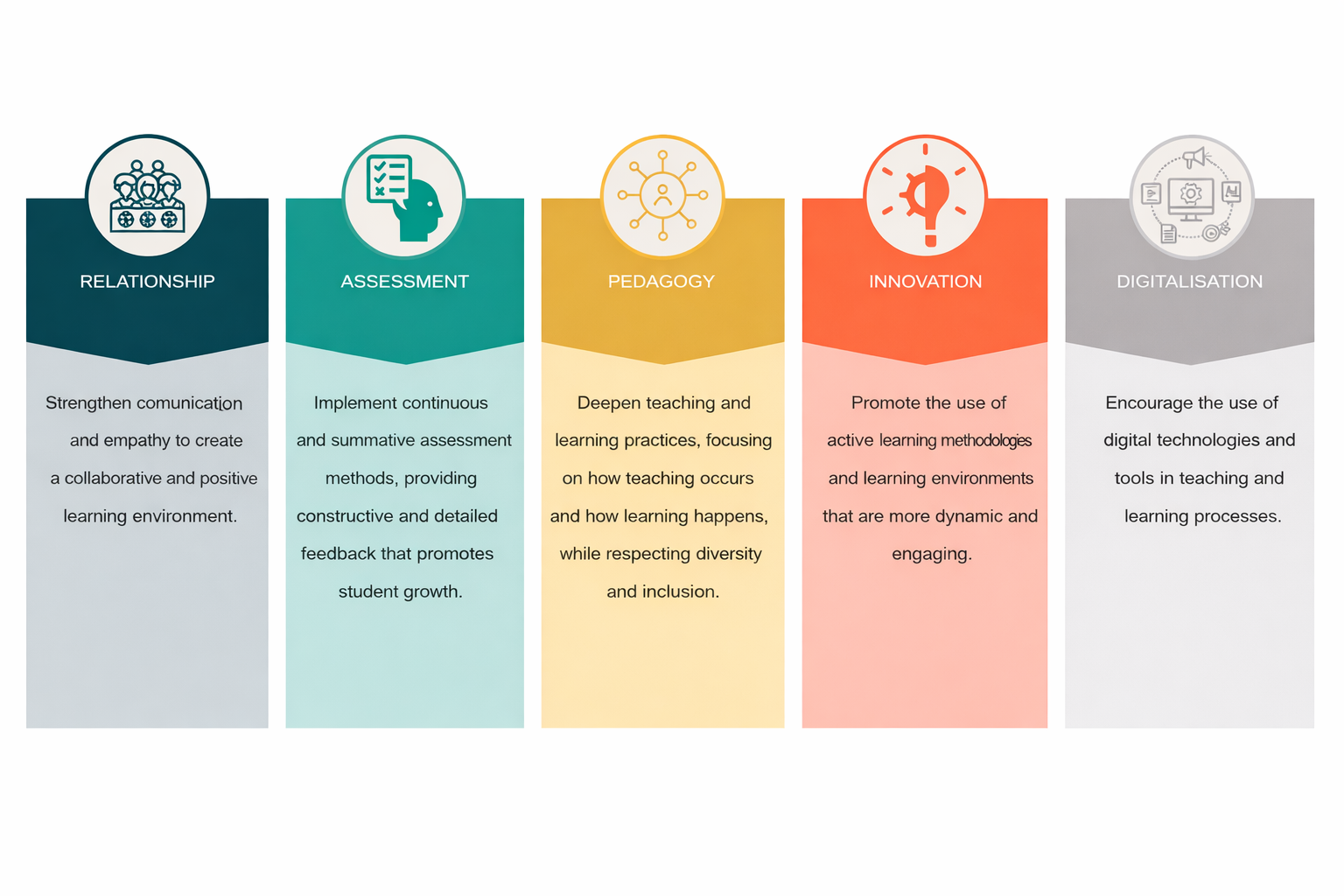
RAPID Framework: five pedagogical development areas designed to inform the selection of academic staff training.
- [1] L. S. Vygotsky, Mind in Society: The Development of Higher Psychological Processes. Cambridge, MA: Harvard University Press, 1978.
- [2] P. Black and D. Wiliam, “Assessment and classroom learning,” Assessment in Education: Principles, Policy & Practice, vol. 5, no. 1, pp. 7-74, 1998.
- [3] L. W. Anderson and D. R. Krathwohl, A Taxonomy for Learning, Teaching, and Assessing: A Revision of Bloom’s Taxonomy of Educational Objectives. New York: Longman, 2001.
- [4] J. Biggs, “Enhancing teaching through constructive alignment,” Higher Education, vol. 32, no. 3, pp. 347-364, 1996.
- [5] J. Piaget, The Origins of Intelligence in Children. New York: International Universities Press, 1952.
- [6] Marques, A., Moura, G., Simões, P., & Wahl, R. (2025, março 27–28). O impacto do Programa de Desenvolvimento Pedagógico do Técnico no percurso de Professores e Investigadores Auxiliares [Poster]. Congresso Internacional de Saúde Mental no Jovem Adulto, Coimbra, Portugal.